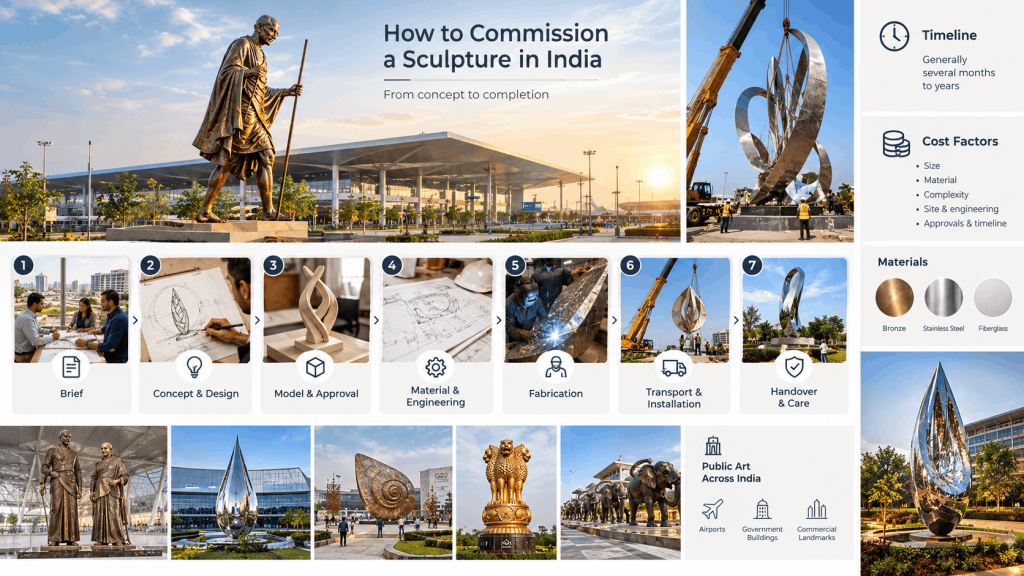
How to commission a sculpture is a question that architects, developers and institutions ask before almost every large project. In short, you share your site, purpose and budget range with a sculptor, approve a design and a scaled model, agree on the material and timeline, and then let the studio fabricate and install the work. In most cases, the process takes many months, because the final timeline and cost depend on size, material and complexity. This guide explains each step in plain language, with real examples from sculptor Vivek Kumar.
What are the steps to commission a sculpture?
Although every project is different, most follow the same seven steps.
- Brief. First, describe the location, the message, the approximate size and any approvals needed, such as airport, municipal or government permissions.
- Concept and design. Next, the sculptor presents sketches or digital renders that fit the site and the story.
- Scaled model and approval. Then, a model is reviewed and signed off before any large-scale work begins.
- Material and engineering. After that, the team confirms the material, the structure, the foundation and the wind-load requirements.
- Fabrication. Meanwhile, the sculpture is cast or built, usually in sections, with progress checks along the way.
- Transport and installation. Afterwards, the sections are delivered to the site, lifted into place and finished.
- Handover and care. Finally, the client receives maintenance guidance for the long term.
To see how the building stage actually works, read how monumental sculptures are made.
How long does it take to commission a sculpture?
Small and mid-size works can take a few months. However, large public installations usually take longer, because of design approvals, fabrication in sections and site preparation. In addition, delays often come from approvals and site readiness rather than from the sculpture itself. Therefore, ask for a stage-wise schedule at the very start, and confirm who is responsible for each stage.
What decides the cost of a sculpture?
There is no fixed price list, because every sculpture is different. Still, five factors drive most estimates:
- Size: height and volume change the material and labour required.
- Material: bronze, stainless steel and fiberglass differ in cost and build time.
- Complexity: portraits and fine detail take more hours than simple geometric forms.
- Site and engineering: foundations, cranes, lighting and access add to the total.
- Approvals and timeline: tight deadlines or several review stages can change the plan.
For this reason, a reliable studio gives a written estimate only after seeing the brief and the site.
How does material choice affect the project?
Material affects the look, the weight, the build time and the long-term upkeep. For example, bronze suits realistic figures, while stainless steel suits modern, reflective forms, and fiberglass suits large, light works. As a result, choosing early saves both time and money. If you are still deciding, this guide to the statue material compares all three options side by side.
Which approvals do you need for a public sculpture?
Public spaces usually need formal permission. For instance, airports, government premises and municipal land each have their own approval process. Moreover, designs for national symbols or statues of leaders often need extra review. Your sculptor can guide you on the documents and drawings required. Even so, approvals remain the client’s responsibility, so start this step early.
What kinds of projects have been delivered at scale in India?
Public sculpture in India covers airports, convention centres, government buildings and commercial landmarks. Examples by Vivek Kumar and Universal India Studio include:
- The Gandhi and Patel statues at Ahmedabad Airport.
- The 80-foot Droplet sculpture at Surat Diamond Bourse.
- The 20-foot Shankh (conch) sculpture at the G20 Summit venue in Pragati Maidan.
- A 250-foot National Emblem for the Chief Minister’s office building in Hyderabad.
- Four life-size elephant sculptures at Terminal 3 of New Delhi Airport.
You can browse more finished works on the Landmark Artworks page.
What should you ask a sculptor before you sign?
Before you commit, a few direct questions can prevent problems later:
- Can you show similar completed public projects?
- Who handles engineering, transport and installation?
- What is the stage-wise timeline and payment schedule?
- What maintenance does the finished work need?
- What happens if the site or the approvals change?
What are the red flags to watch for?
On the other hand, some warning signs are easy to spot. Be careful if a studio has no completed public installations to show, quotes a fixed price without a brief or site visit, skips the scaled model stage, or gives vague answers on installation. Likewise, avoid any studio that cannot give a written timeline.
How do you start the process?
Simply send a short brief that covers your site, the idea or story, the approximate size, your budget range and your deadline. Vivek Kumar’s studio is based at HN 3172, Sector 46, Gurugram, Haryana 122003, and can be reached at oresales@gmail.com or universalindia@gmail.com.
Frequently asked questions
How much does it cost to commission a sculpture in India?
There is no fixed price. It depends on size, material, detail and installation. Therefore, request a written estimate based on your brief and site.
Do I need government permission for a public sculpture?
Often yes, especially in airports, government premises and public spaces. Your sculptor can guide you, but approvals are the client’s responsibility.
Can the sculptor handle installation as well?
Yes, many studios, including Universal India Studio, deliver fabrication and installation together. However, confirm this in writing before you start.
Can I see a design before the final work begins?
Yes. In fact, a scaled model or digital render should always be approved before full-scale fabrication.
What is the first step to commission a sculpture?
Share a clear brief with your site, purpose, size and budget range. Then the sculptor prepares a concept for your approval.
By Vivek Kumar, sculptor, Universal India Studio, Gurugram.