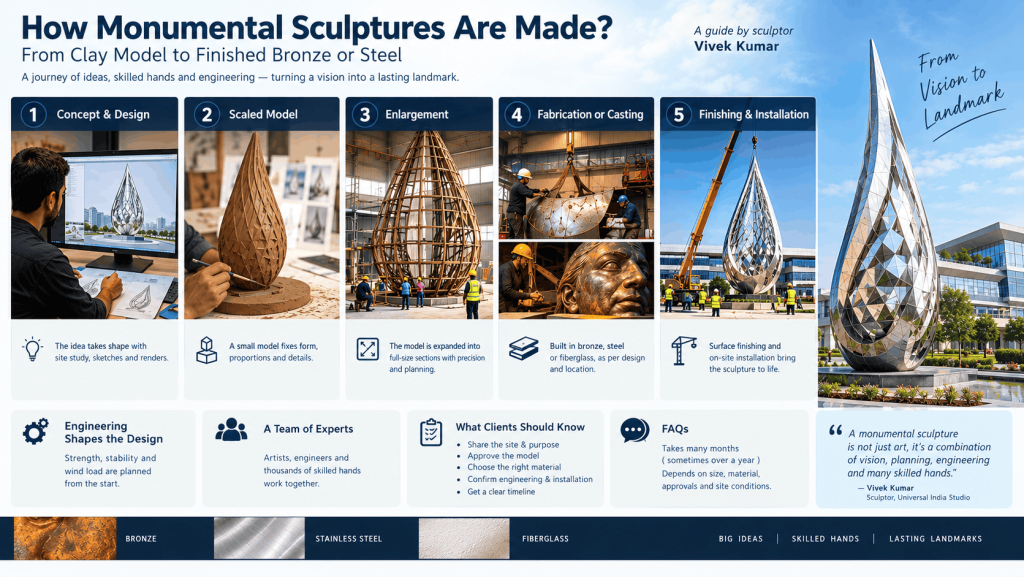
How Are Monumental Sculptures Made? From Clay Model to Finished Bronze or Steel
A monumental sculpture is made in five stages: concept and design, a scaled model, enlargement, fabrication or casting in the chosen material, and finishing with on-site installation. In most cases, large public works take many months, because the timeline depends on size, material, approvals and site conditions. This guide explains each stage in plain language. Moreover, it uses examples from the work of sculptor Vivek Kumar.
What is a monumental sculpture?
A monumental sculpture is a large artwork made for a public or institutional setting, such as an airport, convention centre, government building or commercial landmark. People see it from far away, and it often has to stand outdoors for decades. As a result, it is closer to a piece of engineering than a studio object. Therefore, planning matters as much as craft. You can see several examples on the Landmark Artworks page.
Stage 1: How does a sculpture begin?
First, every project starts with a brief. The artist studies the site, the surrounding architecture, the audience and the story the work must tell. After that, sketches and digital renders help the client see the idea in its setting.
Good concepts are simple enough to read from a distance. For example, the Droplet sculpture at Surat Diamond Bourse is a droplet shape with diamond-style cuts. Because of this, it links the sculpture directly to the bourse as a hub of the diamond trade.
Stage 2: Why is a scaled model made first?
Next, the artist makes a scaled model, often in clay, to fix the form, proportions and details. The model is also where the client approves the work. For instance, changing a small model costs very little, while changing a finished 80-foot structure costs a great deal. In addition, a model lets engineers check weight, balance and wind load before any expensive material is cut.
Stage 3: How is a small model enlarged?
Then, the approved model is turned into full-size patterns or sections. This can be done with careful hand measurement, with 3D scanning and digital modelling, or with a combination of both. Large works are almost always divided into sections, so they can be built, transported and lifted safely. Accuracy at this point matters a lot, since it decides how well the sections fit together later.
Stage 4: How is the sculpture built in the chosen material?
The material shapes the look, the weight, the cost and the build method. Therefore, choosing it early is important. Here are the three most common options:
- Bronze: First, the work is cast in sections, often using the lost-wax casting method. Then it is joined and finished with a patina. Because bronze captures fine detail in faces and fabric, it suits portrait and life-size figures, such as the Gandhi and Patel statues at Ahmedabad Airport and the four life-size elephant sculptures at Terminal 3 of New Delhi Airport.
- Stainless steel: In this case, sheets are cut, formed, welded and polished to a mirror or satin surface. Stainless steel grade 316 resists corrosion well outdoors, which is why the 80-foot Droplet is made of it.
- Fiberglass: Since it is built from moulds, it is light and suits very large forms. Similarly, the 20-foot Shankh (conch) sculpture at the G20 Summit venue in Pragati Maidan was made in fiberglass.
Not sure which material to pick? Read our guide to bronze vs stainless steel vs fiberglass statues
Stage 5: How are surfaces finished and the sculpture installed?
Finishing depends on the material. For example, bronze receives a chosen patina, stainless steel is polished, and fiberglass is coated or painted. After that, the sections are transported to the site in a planned sequence.
Installation begins with a foundation designed for the sculpture’s weight and the local wind and weather. Next, cranes lift the sections into place, where they are joined and checked for alignment. Finally, the surface is cleaned and inspected.
How does engineering shape the design?
Tall sculptures face constant wind and weight loads. For this reason, engineering input is needed from the start, not at the end. The internal structure, the thickness of the material, the joints and the foundation all affect safety and lifespan. Consequently, a good studio plans these details during design. As a result, the finished work looks effortless while staying stable for decades. The National Emblem made for the Chief Minister’s office in Hyderabad, with an installation height of 250 feet, shows how important this planning is at scale.
Who actually builds these works?
Large sculptures are team projects. Universal India Studio, founded by Vivek Kumar, works with over 45,000 artisans across India and with materials including metal, non-metal, fiber, wood and canvas. In addition, its research and development team tests new material combinations.
The scale of this coordination is easy to see at the G20 Summit venue in Pragati Maidan. There, the team designed the full art concept. It included a 20-foot fiberglass Shankh at the entrance, eight fiberglass discs of eight feet each inside, and 452 fiberglass dias on the walls.
What should clients know before starting a project?
Before you begin, a few simple steps can save time and money:
- First, share the site, purpose and story early, ideally with photos or drawings.
- Second, approve the scaled model before full-size work begins.
- Third, ask which material suits the location and why.
- Also, confirm who handles engineering, transport and installation.
- Finally, request a stage-wise timeline and a maintenance plan.
For a complete walkthrough, see how to commission a public sculpture in India.
Frequently asked questions
How long does it take to make a monumental sculpture?
It usually takes many months, and sometimes more than a year for very large or complex works. Size, material, approvals and site readiness all affect the schedule.
What is the first step in commissioning a large sculpture?
First, share the site, the purpose and the story you want the work to tell. Then the sculptor prepares design concepts and a scaled model for approval.
Can a sculpture be made in more than one material?
Yes. In fact, many large works combine a structural frame with a bronze, steel or fiberglass skin, depending on weight, budget and the look required.
Why are large sculptures built in sections?
Sections are easier to cast or fabricate accurately. Moreover, they are simpler to transport on roads and lift by crane. Afterwards, they are joined on site on a prepared foundation.
By Vivek Kumar, sculptor, Universal India Studio, Gurugram. Follow his work on Instagram and Facebook.